# Cumulative Reasoning With Language Model

这是一篇 2023 年发表在 arXiv 上的[论文](https://arxiv.org/abs/2308.04371)，领衔作者为**姚期智**。该论文提出了一种 LLM 解决复杂问题的方法——模仿人类思考过程，将复杂问题递归解决。文中该将方法命名为 Cumulative Reasoning(CR)。

该论文指出现存 LLM 的问题在于忽略了对人体第二认知系统的模仿，导致推理效果不佳。同时指出 CR 相较于现有 CoT / ToT 方法的优势在于其数据结构类型为 DAG，具有更高的自由度，面对复杂问题具有更强的可扩展性。

CR 主要部署了 proposer、verifier 和 reporter 三个 LLM，通过三个 LLM 的协同合作，实现对复杂问题的解决。

<figure><img src="/files/lp0yRZjmjDkQBEfFHLFL" alt=""><figcaption><p>流程图</p></figcaption></figure>

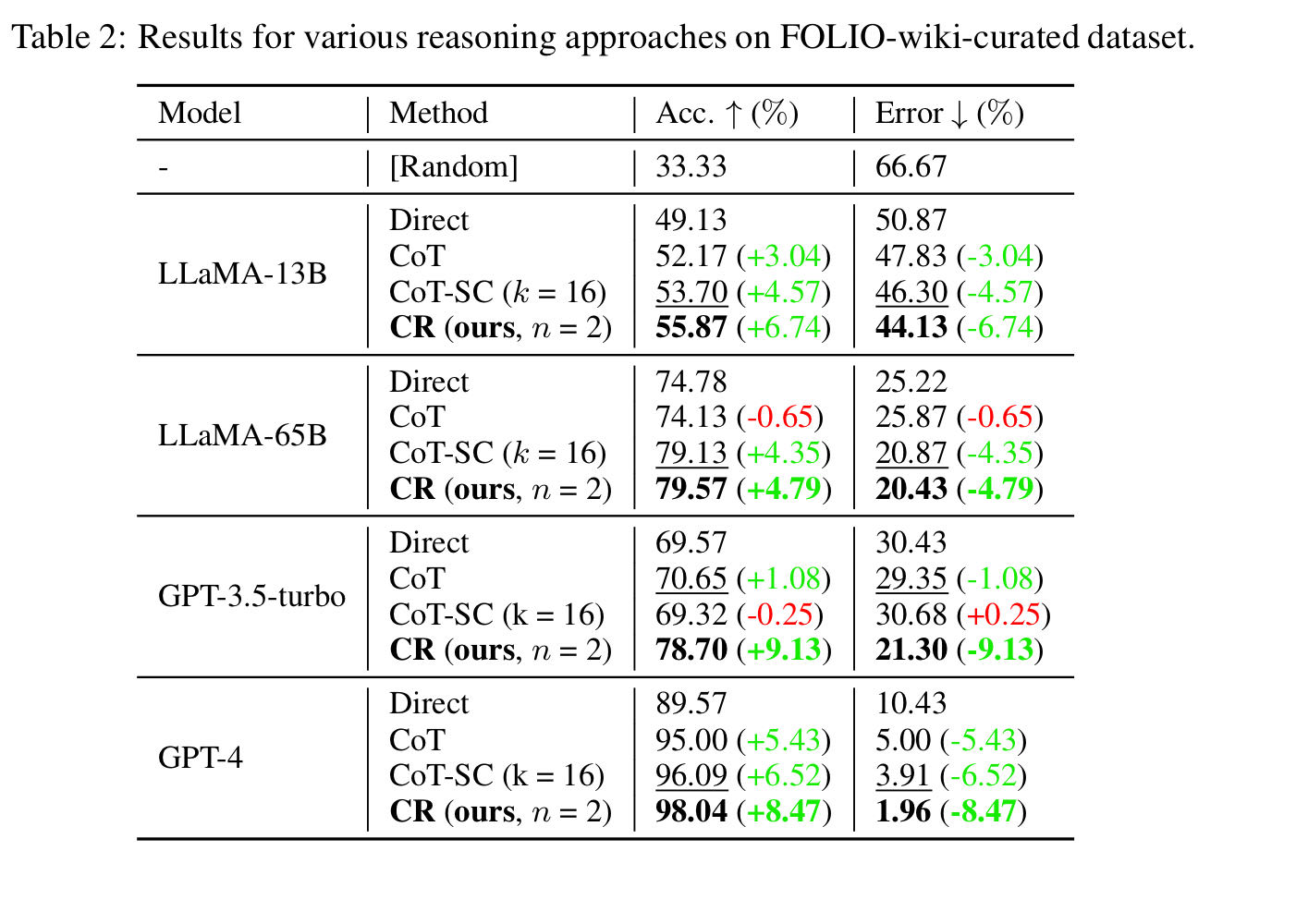
<figure><img src="/files/CeUspNp11sEnRJQpOVa5" alt=""><figcaption><p>部分实验效果</p></figcaption></figure>

ps：顶级论文确实不一样，观点鲜明，论述言简意赅，实验效果显著（开始实验效果不好，直接找数据集的问题，确实硬核🤣），这是笔者目前为止阅读体验最佳的论文。


---

# Agent Instructions: Querying This Documentation

If you need additional information that is not directly available in this page, you can query the documentation dynamically by asking a question.

Perform an HTTP GET request on the current page URL with the `ask` query parameter:

```
GET https://blog.kaisuping.cn/paper-reading/others/cumulative-reasoning-with-language-model.md?ask=<question>
```

The question should be specific, self-contained, and written in natural language.
The response will contain a direct answer to the question and relevant excerpts and sources from the documentation.

Use this mechanism when the answer is not explicitly present in the current page, you need clarification or additional context, or you want to retrieve related documentation sections.